Birdwatching in Morocco
We land in Morocco on a cloudy Monday afternoon. As we walk out of the airport, we look at an expectant crowd in the Arrivals area - there has to be a driver who will take us to the Atlas Mountains. We were told that he would be holding a card with our names. We were told that we cannot miss him.
Well, we missed him.
Soon I receive a call by Bruno, the owner of the Atlas Mountains eco-lodge we are heading to. He apologises for the delay, explaining that the storms compromised the electricity in the village, and his messages have not reached the driver. Bruno tells me that the driver will be there in 10 minutes. The driver calls us to tell us that another driver is coming to pick us up in 20 minutes. After 30 minutes, we meet Omar.
Shortly after we start our trip with Omar, he stops and tells us he will be back in 2 minutes. We stop at a fried fish joint, a tent with a bunch of tables covered with baskets of flatbread, plates of fish, and local cats stretched on their behind legs begging for leftovers. We are happy for Omar's excellent lunch choice and an opportunity to observe a local food scene. However, a minute later we see an angry-looking gentleman chasing scared-looking Omar back to the car. Turns out that an undercover police officer - or one that was too lazy to put on his uniform that morning - found us parked in a place where we shouldn't have been. Or so we assume, we have, frankly, no idea what is going on.
The cats are waiting for fish. We are waiting for Omar.
Omar seems stressed, as the angry man is waving his driving license in hand, voice raised, which makes us realise that we are stuck here for a little while. Soon a police car arrives, Omar pays a fine and shows us a handwritten fine note. We offer our sympathy for an unpleasant situation and start our trip again, driving through the construction sites of luxury villas and gas stations. Curiously enough, soon we stop again, this time at a gas station. Omar beeps his car horn, and a young lady dressed in pastel clothes rushes out, sparing a moment to smile at me. It turns out that Omar went through all that trouble just to bring a meal to his wife. Our appreciation of Omar - and our sympathy for him having to handle a tad aggressive police officer - grows.
There are all sorts of sights I see along the road. A man with a bike is climbing over a fence - raising his bike over it first, ready to drive through a fields. Omar gestures for us to look on the right, where we see napping camels in a lush green meadow. After the recent storm the spring is hitting with full force, so the desert has turned into a poppyseed field.
Soon we start seeing snowy mountain peaks on the horizon, and we know we are getting close. We turn into a narrow road lined with pottery stands, and shortly after drive through a gate, opening into a garden. We arrived.
We say goodbye to Omar and say hello to Hussein, whom we follow through a winding tile path along fig trees, pomegranate trees and giant cacti. Once we reach a hut, that we will get to know as a breakfast, lunch, dinner, and reception space, we finally meet Bruno. Bruno, it turns out, is a French-speaking man in, we assume, his eighties. He speaks slowly, and I mean, really slowly. He is wearing a shirt, a sweater and a winter jacket. Which, frankly, scares us off, as, you know, we came to Morocco mid-spring and did not expect to open a wormhole straight back to winter. Bruno tells us that his guests usually describe the eco-lodge as heaven, but today it is hell - in his entire life he has never seen such tree-bending wind in these lands.
Bruno leads us to our hut, encourages us to check the view from the terrace, and then runs the faucet for a couple of minutes to show us that it may take a while to get hot water. We get it. We also start to get that we entered a different realm after all, as everything here seems to come through storytelling. There is not a single booklet, welcome card, map, or anything else resembling factual information. Bruno asks us when we'd like to get dinner. We ask when it is possible. He says anytime. Then in an hour, we say. But the restaurant opens at 7 PM, Bruno tells us. We'll have it at seven then, we say.
The dinner is served by Rita, a shy smiley lady, who puts a small dish of olives and a bottle of olive oil in front of us. A chicken tagine soon follows. Bruno emerges from the nearby olive trees to ask us how we enjoy our dinner, and to tell us that they used to grow all sorts of fruits and vegetables, but wild boars would snatch them all - apparently, they would even find a way to shake plum trees to grab those too. So olive trees were the only ones that were left, useful enough for human beings, unappetising enough for wild boars. Perfect symbiosis. Bruno also mentions that tomorrow is a souk day - once a week, the local village has a market. We make a mental note to visit.
A kid rushes by us shouting after a grey fluffy cat. The cat is named Pickles. We are not quite sure how or why there is a cat in Morocco named Pickles, but we roll with it. Stars are starting to shyly come out - it is getting dark and I can barely see my chocolate cake served for dessert. We ask at what time is breakfast. Anytime, Rita says.
Next morning we wake up at dawn and go to read to a cactus forest. I am reading a book on moral philosophy, Marco is reading one on the geopolitics of the Baltics. We exchange anecdotes from the books and reports on our hunger levels, and soon we come back to the breakfast-dinner-reception area. The breakfast is served on the red chequered tablecloth covered with a basket of toast, olive bread and brioche buns, accompanied with a ball of butter, bowls of honey, strawberry and peach jams, foil-wrapped triangles of creamy cheese, glasses of cubed fruit and a bottle of freshly squeezed orange juice. It is a lot of food, and I get a mild sugar rush soon after. We will need our energy for the souk expedition though, so we eat gratefully, absorbing the late morning sun. Pickles is observing us from afar.
As we walk out the gate, a herd of goats and sheep cross the road. Their shepherd waves at us. We wave back. A few meters in we stop again, as we notice these massive bright blue birds on a leafless tree nearby. Marco identifies them as European Rollers. One takes off, spreading its terracotta-red wings in the air. There are a couple. We watch the couple for a while. I identify a consistent sound, a call maybe, and I look around. On the other side of the road, behind a metal fence, there is a toddler quietly calling and waving at me. I wave back. We set off down a red dusty path. A few kids pass us. They shyly wave. We wave back. It seems to be a waving culture. I feel like the queen of England.
As we approach the centre of the village, more looks fall on us. We are holding hands, which is probably an unconventional choice. My hair is not covered. Otherwise I am dressed like a respectful young lady, so I hope that no one is too insulted by my presence. But the looks are mostly curious, not hostile, especially from kids and groups of teens next to a local school. Girls giggle and look fascinated. I smile at them back, just as fascinated.
We keep following Bruno's directions - just follow the main road and you will reach souk in 15 minutes - but the souk is nowhere to be found. The vast majority of people on the streets are men, but I spot a woman, and she has a big empty bag, giving us hope to reach the market after all, so we start to - non-creepily - follow her. I look back, and there is a man with a basket on the wheels following us. We seem to be heading in the right direction. However, the lady soon turns and enters the building, and our hope to find the market is close to gone. We see a supermarket, and walk inside to at least grab a snack or two. As we approach the checkout counter with a bag of peanuts and pistachios, Bruno enters the store. We look at each other knowingly - Bruno always shows up when you need him the most. We walk up to him, and ask about the souk. He assures us that it is around the corner - just 15 minutes away from here. And so we carry on walking.
Soon we reach the souk, that seems to be formed in circular trajectories, this nonlinear thinking revealing itself even in the market logistics. It starts humbly. Sandals, some of which look worn, are displayed on big sheets. Bunches of fresh parsley. Some mysterious herbs. It quickly grows into a busy flow of words, waves and chickens. Cages with live chickens are stacked right next to their skinned friends, as well as their quartered counterparts. There's a milky eyed chicken, maybe blind, looking at this bright world darkly. I see a head of a goat with its insides dripping on a table. Dates melting in the sun. Piles of walnuts. We don't hear too many shouts addressed at us, other than a cheerful gentleman glancing at us and quickly exclaiming out moneymoneymoney at an impressively quick succession. I start to get a bit dizzy, and we find a way out with some effort. On the way back, kids wave again. I figured I should try and initiate too. At the next opportunity, I wave to a group of boys and girls. Some girls look embarassed and run to the boys for apparent protection. Other girls laugh like I am the most hilarious being who has ever walked upon this earth.
The afternoon is much calmer. Nightingales are chirping. Cuckoos are cuckooing. It smells like a mixture of orange blossoms, rain and manure. I can hear sheep in the distance, as I read under a blooming pomegranate tree while Marco is trying to spot rare birds. We decided to turn off our phones upon arrival and I am starting to forget that phones exist, regaining the pleasure of my mind wandering through the sounds, my gaze wandering through the trees and the mountains on the horizon. Soon Bruno emerges from the bushes, and tells us the story of the land.
His parents bought it before he was born. I ask him how long ago it happened. In ten years there will be a hundred years, Bruno says. Some of the trees have never been cut to provide shade in summer - that is why some olive trees and fig trees around us look ancient. In gratitude, these trees helped to protect the land from the 7.0 magnitude earthquake in 2023, the roots absorbing the impact - barely anything got damaged here. A snow-white cat appears - not Pickles this time - and Bruno starts telling us her story. His companion comes from the lake region in Turkey and is obsessed with water, staring into narrow canals, rainy paths and even dipping her paws in the pool. According to Bruno, Google says that these cats dive into lakes. Who am I to doubt it.
Since we don’t know when we will see Bruno next, we use this opportunity to arrange a hike with a local legendary guide Latifa for the next day. She will take us up the Atlas Mountains, from the 1000 metters elevation that we are staying at to about 2000 meters, where the terrain looks significantly different. We cannot wait.
Our dinner is couscous with beef, pumpkin and zucchini. That portion could feed the whole family, and we do our best to make some progress, but have to admit defeat. We gesture to the cook that our bellies are beyond full and cannot handle any more food. She smiles proudly. We use a translation app to tell her it was delicious. She gestures that she cannot see what's on the screen, finds another person to read it, the person reads it, notes it, passes the message. The eternal storytelling. The message is received.
At half past eight, as the fire in our fireplace starts to die down, we hear a knock on the door. A Moroccan gentleman responsible for kindling fireplaces is now visiting us on a whole different mission, pointing to his phone, saying Latifa. We take the phone as offered, and try to navigate a non-smartphone for the first time in years - to no avail. No recent call logs, no messages from anyone. No Latifa in the contacts. We shrug trying to wordlessly express an unsuccessful attempt, thank him for his effort, and repeat Bruno’s name, to reassure him that we will solve this. He seems content to be finally free to go. So we connect to the world wide web for the first time since our arrival to hunt Latifa down. Fifteen minutes later, the mission is accomplished. We are lucky she’s famous, Marco says. Turns out, she just wanted to meet half an hour later so we have a higher chance of spotting a rare eagle. We cannot wait even more.
The next morning the sky is looking bright and upbeat. In an hour that it takes us to drive to the hiking spot, we learn a lot from Latifa. She tells us about how the role of a guide is shifting - in the past, there have been instances where guides, especially male guides, would try to get friendly with the European tourists, especially female tourists, with a hope of an eventual EU visa. The society is shifting too - there has been a serious effort to return girls to school. Otherwise many of them stop going to school around twelve, and start having babies around sixteen years old. Babies having babies, Latifa says. She tells us that the current king changed the law to raise the minimum marriage age to 18 years old, and only if the girl agrees to marry. I ask how communities reacted to it. She says that people are happy, especially the mothers of the girls. That is not the only change for the local women. The earthquake exposed how vulnerable landless women were, prompting the king to reform the inheritance law - allowing families to pass land directly to their daughters for the first time, bypassing centuries of tradition that had always favoured sons.
We talk about it as we keep driving up the mountain. We pass some large colourful metal containers. It turns out that they are local schools - the replacements of the ones destroyed by the earthquake. The snowy mountain tops start peeking over the horizon. Marco asks Latifa if there will be a chance to go to a bathroom in the upcoming hour. Of course, she says, and the car stops right away. So Marco walks away to use the meadow bathroom with a stunning view, while I stay in the car. Latifa says that we could just drive away. We could kidnap you, she adds. We laugh. My laugh is slightly cautious, but hey, Latifa seems to be a trustworthy lady, and if anything, her joke just confirms it. Marco soon returns all excited that he spotted Thekla’s lark, so it turns out that while I sat in the car being offered an experience of kidnapping, he was wandering around the meadow birdwatching with his monocular. Classic.
Soon we leave the car and start walking. Marco asks Latifa if this is an official mountain path, and that is how we learn that she created this whole itinerary. Indeed, the path is not quite a path, and we are led through a rocky field with no visible trail whatsoever. We soon reach a Berber village - home to the indigenous people of North Africa who predate the Arab arrival by thousands of years. Latifa says hello left right and center, eventually knocking on a door of a gray-bricked house. Traditional Berber housing is made of clay, but the village has been destroyed by the earthquake, and these modern buildings replaced the old houses. A lady comes out and smiles, greeting Latifa and us. She tells Marco that he looks like a Berber person, with light skin and dark hair. Latifa makes afternoon plans with her, so we can come over after a hike for tea and bread. We hug goodbye as if we were friends. Tiny kittens all around the house are cautiously staring at me.
Latifa is a popular lady. She keeps jumping on calls - checking the weather conditions on the mountain we’re heading towards, checking up on her other clients, and planning other hikes. She also seems to know every single person in this village and mountain range. I ask if she actually does. She confirms it. Indeed, as we keep walking, she checks on people. She asks why a teen is not at school. He tells her that the storms from earlier this week destroyed the school. Minutes later she is on a call to arrange a temporary school building. We pass another villager, she discusses the problem in a couple of sentences and now the consensus seems to be that the temporary buildings are too easily affected by the storms and something more robust is needed. She’s on it. I ask if they have enough teachers. Latifa says that it is not a problem here - buildings are. It makes me think of a lack of teachers across most of Europe, with plenty of buildings to spare. Here in the Atlas Mountains, it seems to be the opposite.
We keep walking, and soon we are surrounded by mountains, painted yellow and red by different forms of iron. It almost looks like the Grand Canyon, these massive textured boulders, glimmering in the sun as the clouds part, with a fig tree fighting its way through the rocks. We soon pass a hut, camouflaging into the yellow rocks. There is no road, and it is even hard to see a path - although we see a person on a donkey riding ahead of us. Latifa asks us if we want a photo with the farmer, after we have been staring at his goats, sheep and chickens for a minute. He looks just as confused as we are. We take a photo as a three legged cat hops past us.
I ask Latifa how people see tourists here. She tells us that often locals only see foreigners through - horrific - news on TV. Her goal is to expose the locals to the tourists, so that they can challenge their own stereotypes, realising that Americans do not shoot children daily, and the women in Europe are not just, well, sluts. Apparently, the people are happy to meet us Europeans. The feeling is reciprocal.
We pass a meadow full of yellow flowers and Latifa asks us if we want a photo, again. We agree, and Marco hugs me. Latifa seems to appreciate it, exclaims that it is important to love each other, and to show each other your worst sides, as well as the best sides, before getting married. She says it is silly to pretend. Amen, says Marco. I ask Latifa if she has ever been married. She tells us that she is a victim of a tradition - she never got to marry, as she had to take care of her parents, especially her mother who suffered from the Parkinson’s disease. Often, she tells us, the unmarried sibling is expected to take care of the children of other siblings - effectively keeping them eternally busy, without a chance to get a job and get funds to get a property, which is already a problem without a husband.
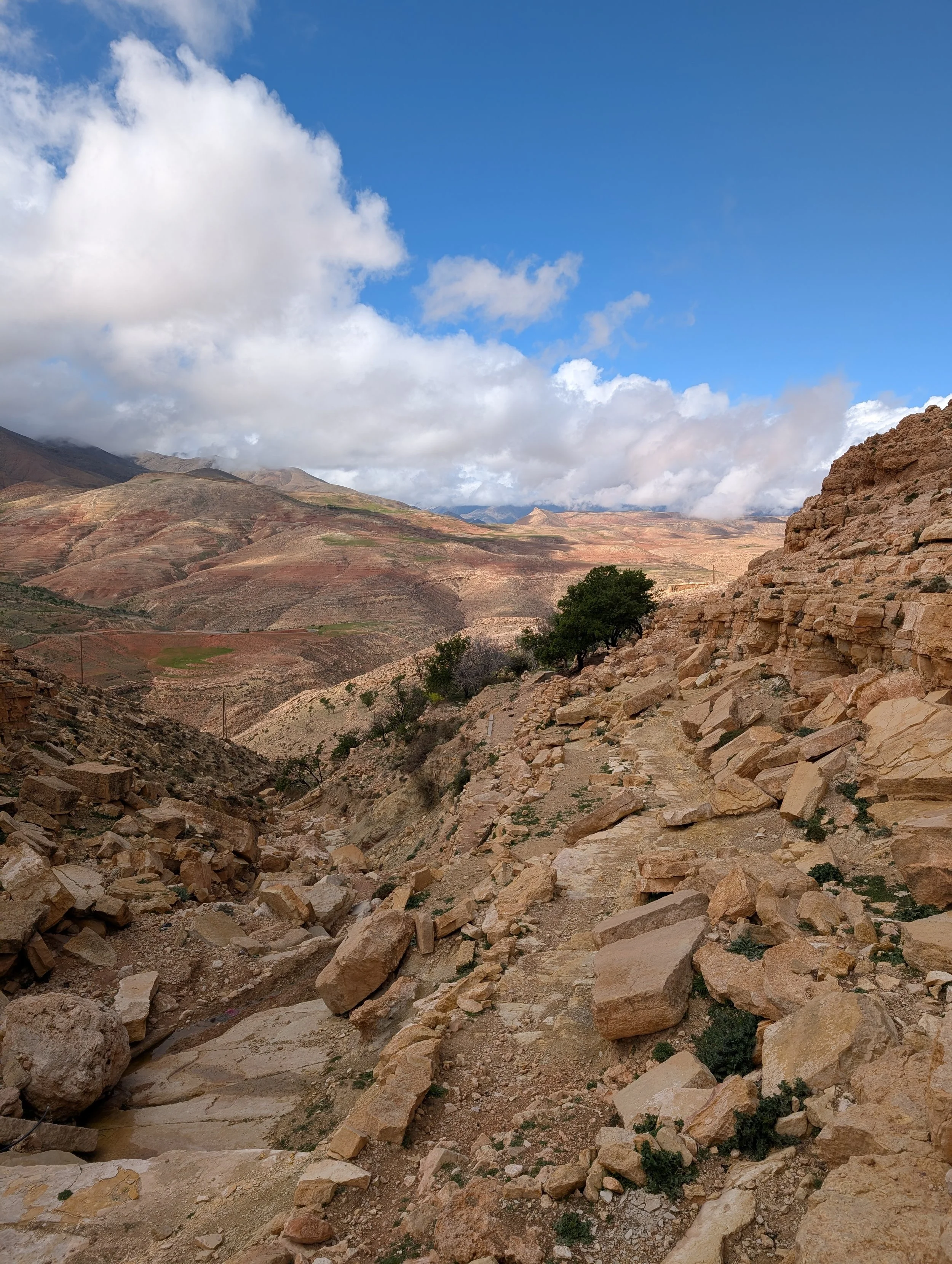
Meanwhile the clouds are gathering, and massive black ravens cross the skies. In fact, they end up following us - we spot a raven every few minutes. After hiking down to the valley and back up the slope, we are sweaty and freezing. Without direct sun, the temperature barely reaches 5 degrees Celsius, and the wind does not allow us to forget it. But our shelter is around the corner.
We enter the home of the Berber village lady, taking off our shoes before stepping onto a carpet and sitting in front of a low table. She brings out sweet mountain thyme and mint tea, walnuts and almonds, chickpeas and peanuts, and wheat barley bread. It’s a tight dark space, with mountains peeking through a small window next to the ceiling. Small paws appear from beneath the table, and a kitten comes out to beg for food.
The lady invites us to step outside as she is about to make bread in the traditional clay oven, slapping it right on the side of it, covering it with ash. More Berber ladies gather up. One says something to me in her own language, and seems surprised when I smile away my confusion apologetically. Latifa translates that she says I am beautiful. As a reciprocal gesture to address their beauty, I ask about their facial tattoos. Two of the three ladies have a decorative line going down their chins. Latifa translates the question and the immediate answer. They ask if I want a facial tattoo too. They are ready to give me one, all we need is juniper ash. We laugh. They laugh, saying that they were crazy in their youth, trying to be beautiful and unique. They are beautiful and unique.
On our drive back, we see goats standing on their hind legs to eat juniper berries straight from the tree. We pass leafy almond trees and walnut trees about to bloom. Latifa recommends that we ask for a lamb tagine with almonds at the eco-lodge. When we say our goodbyes, and go back to the eco-lodge, we find a lamb tagine with almonds on the table.
The last morning of our trip unavoidably comes, and we go on a walk to say goodbye to the birds, sheep and fig trees. We stop at the leafless tree where the European rollers hung out a few days ago. We see one. Then another. I keep staring at their bright blue bodies radiating colour across cloudy skies. Marco hugs me. I look back at him smiling - and see him going on one knee. We get engaged while European rollers are staring at us. You didn’t see it coming? Yeah, me neither.
We say goodbye to Bruno, and even Latifa as she is picking up a new couple to go on a tour. She rushes to give us additional goodbye hugs. Pickles is nowhere to be seen. Omar drives us to Marrakesh, as we text our families and friends about our engagement - our phone fast is over, and the world starts rushing in. But our hearts and minds are full, so it just rushes past us, leaving us feeling utterly content with every part of the day in Marrakesh that is yet to unfold in front of us.